Polymer properties / Molecular dynamics
Polymer density workflows with MACE
I develop polymer-density workflows connecting RadonPy/GAFF2 preparation, MACE molecular dynamics, and reference comparisons. I run simulations, check chemical identity and sampling quality, and analyze how reference matching affects density estimates; the displayed figure records an earlier three-polymer pilot.
Within this research line. This workflow combines classical polymer preparation with MACE density sampling and reference comparisons at 300 K. The displayed measurements retain the separately dated September pilot.
My role. Part of my research on MLIP-based polymer property simulation and evaluation.
Research question
What can short MLIP-based polymer simulations establish about density, and how does reference-data matching affect the interpretation?
Approach
- Simulated polyethylene (PE), poly(4-methyl-1-pentene) (PMP), and polyisobutylene (PIB) using MACE-MH-1, the omol head, and float32 precision.
- Used NPT conditions with targets of 300 K and 1.01325 bar, one initial packing per polymer, and 25 ps of target sampling.
- Compared simulation means and temporal sampling intervals with dataset reference values reported as experimental. The reference table is external data, not measurements made in this work.
Current workflow development
The work has continued beyond the displayed September pilot. Current development focuses on expanding the evaluated set while keeping simulation quality and reference matching explicit.
- Connect RadonPy/GAFF2 classical preparation to MACE density sampling and separate GAFF2 baseline comparisons.
- Check chemical identity, sampling quality, and reference conditions for each comparison; retain blocked or failed cases.
- Manage compute and storage requirements during HPC execution. Input-catalog size, submitted work, and completed property comparisons are different quantities.
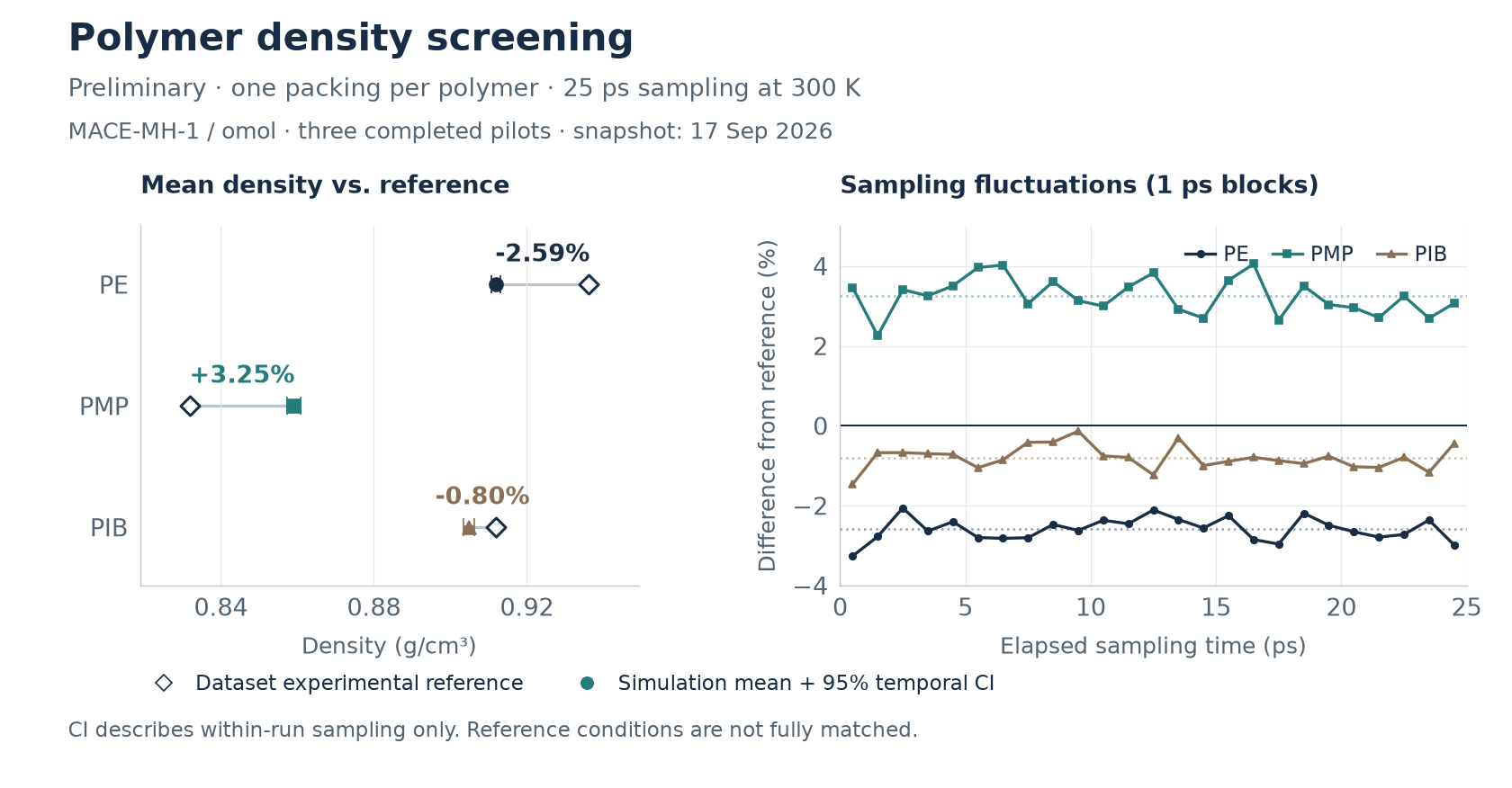
Scroll sideways to read the figure, or open the full-size version below.
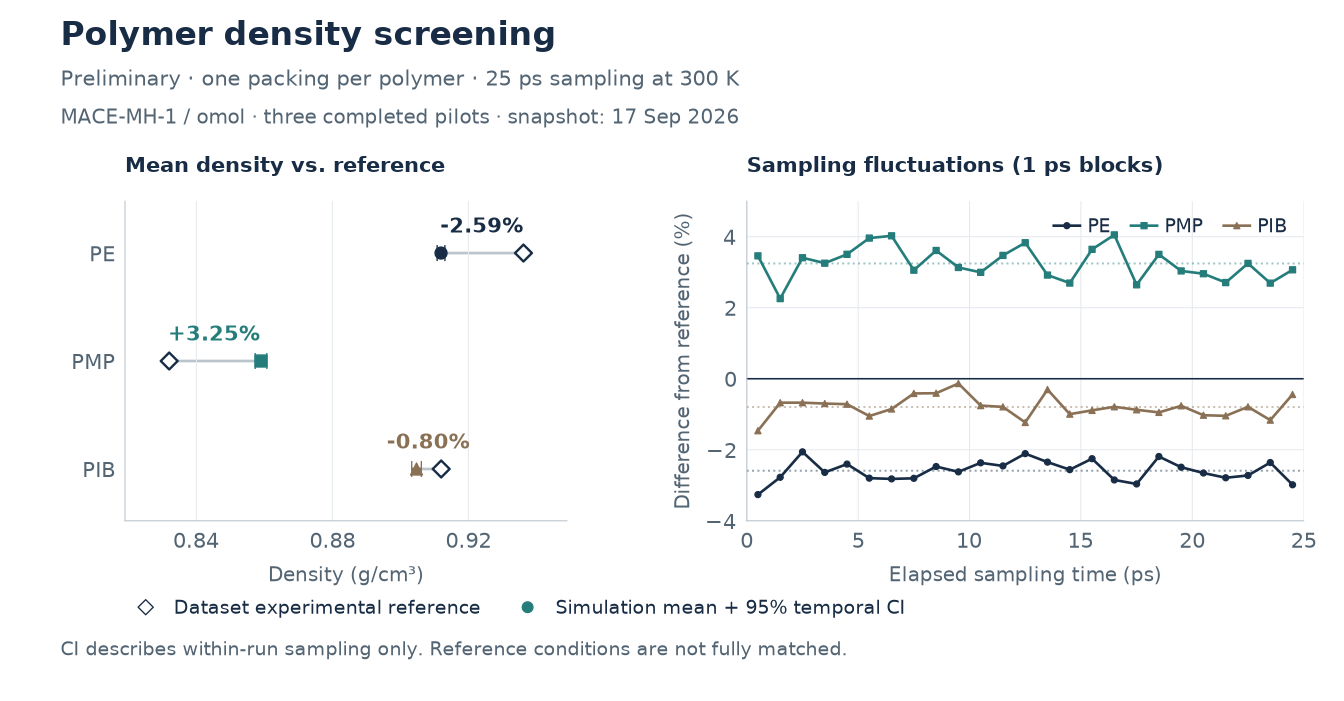
September pilot results (17 September 2026)
- Recorded simulation means were 0.9120 g/cm³ for PE, 0.8590 g/cm³ for PMP, and 0.9047 g/cm³ for PIB.
- Differences from the available reference table were −2.59%, +3.25%, and −0.80%, respectively.
- The three pilots passed the workflow's numerical and sampling checks, while remaining preliminary screening results rather than production-qualified experimental validation.
The numerical results and figure are the original three-polymer snapshot from 17 September 2026. The workflow has continued since then; no expanded-set result or aggregate accuracy is claimed here. A later owner confirmation established that the listed references are at 300 K, while other matching uncertainties remain.
Scope & limitations
- One initial packing per polymer does not measure variation across independent preparations. Temporal intervals cover within-trajectory sampling only.
- The listed reference temperatures were subsequently confirmed as 300 K. Phase, crystallinity, molecular weight, tacticity, preparation history, and experimental uncertainty remain incompletely matched.
- The underlying records remain ineligible for production-level scientific reuse. These three differences must not be promoted as general predictive accuracy.
Data attribution
PolyGraphMT dataset and repository Context for the density reference table. Individual measurement provenance and conditions are not established by the table used here.