ML interatomic potentials / HPC
GPU resource trade-offs in MACE molecular dynamics
To evaluate the resource cost of MLIP simulation, I compared GPU allocations for a fixed MACE polymer workload. I measured wall time, sampled per-device memory, and allocated GPU-hours, and analyzed the trade-off between elapsed time and total compute use.
Within this research line. This engineering pilot compared GPU allocations for a fixed MACE workload, measuring runtime, sampled device memory, and allocated GPU-hours together.
My role. Part of my work on MLIP simulation pipelines and HPC evaluation as a research assistant in Prof. Tengfei Luo's group.
Research question
How should runtime, device memory, and total resource cost be evaluated together when distributing an ML interatomic potential across GPUs?
Approach
- A 3,666-atom polymer system with MACE-MH-1, the omol head, and float32 precision; a fixed workload of 5,500 MD steps (1.375 ps).
- Compared completed two- and four-GPU configurations using the same system, model, precision, and timestep. Wall time excludes queue wait and includes the recorded run stages.
- Measured sampled per-device memory with NVML and calculated allocated GPU-hours. Retained the three-GPU attempt, which failed during MPI/CUDA initialization before model work.
Scroll sideways to read the figure, or open the full-size version below.
What the measurements show
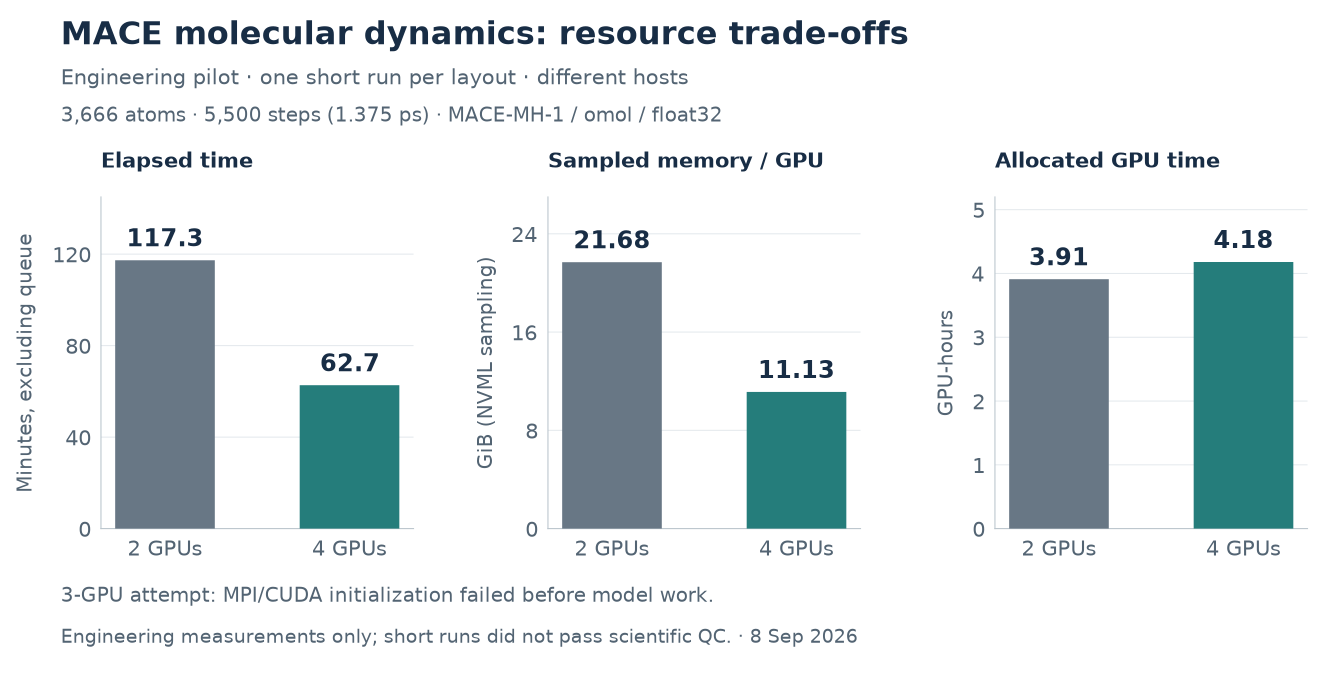
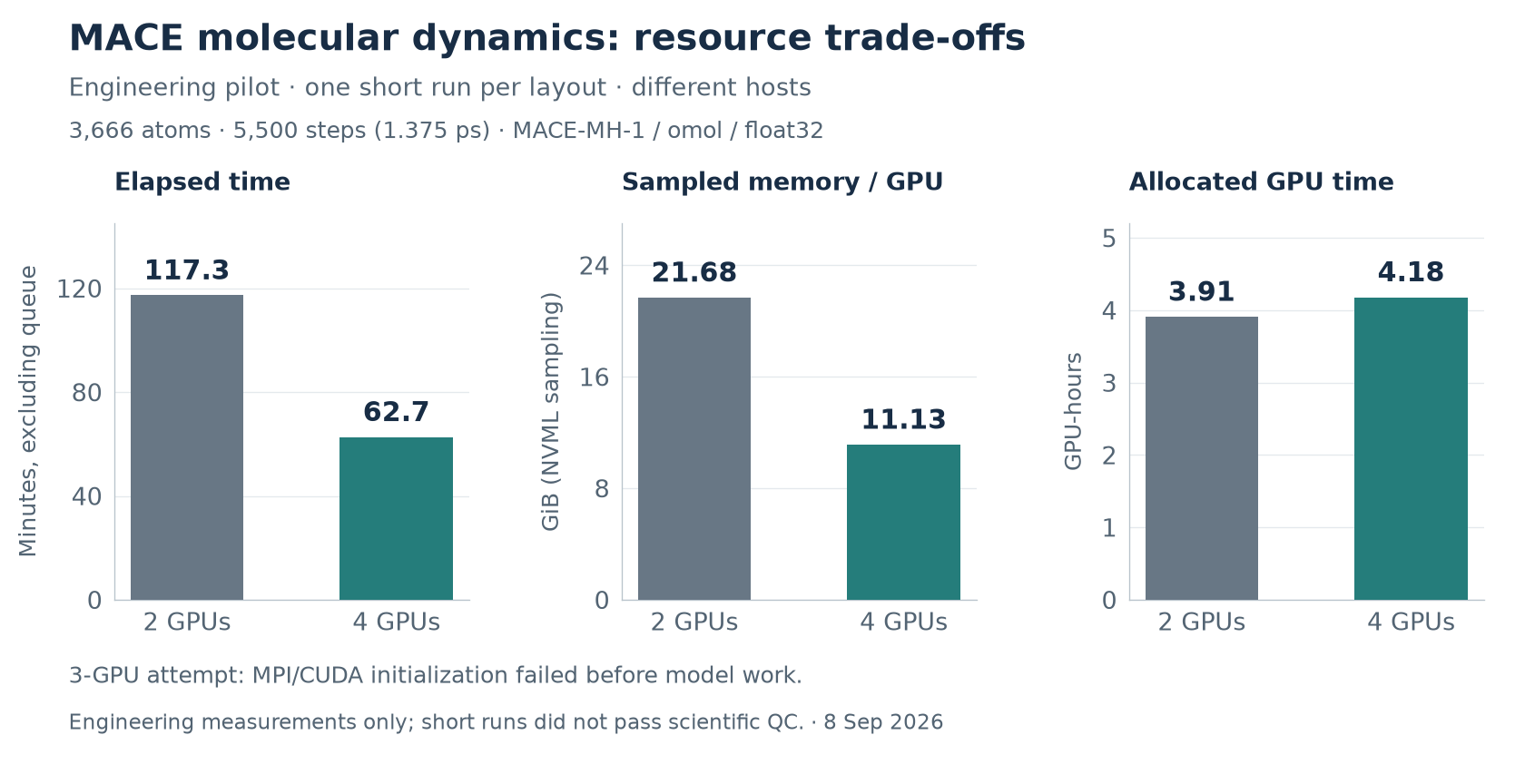
- Observed wall time decreased from 117.3 to 62.7 minutes with four GPUs, a 1.87-fold speedup in this pilot.
- Maximum sampled memory per device decreased from 21.68 to 11.13 GiB. These are NVML samples, not exact allocator peaks.
- Allocated GPU time increased from 3.91 to 4.18 GPU-hours, approximately 6.9% more total GPU time.
The useful result is a measured resource trade-off: lower elapsed time does not necessarily mean lower total compute cost.
Scope & limitations
- Each configuration was run once on different hosts. The observations do not isolate all hardware effects or establish broad scaling performance.
- The trajectories were short engineering tests and failed scientific density quality checks. They are not qualified density measurements or evidence of long-time equilibration.
- This is an evaluation of an existing MLIP workflow, not a claim to have introduced a new model-optimization algorithm.